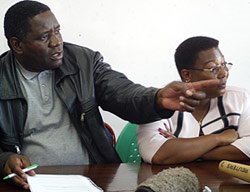
Here we invite Zimbabweans and all concerned friends of Zimbabwe to post their view directly! THE QUESTION IS... "WHAT, IN YOUR VIEW IS THE WAY FORWARD IN ZIMBABWE??????".....POST IDEAS TO mufarostig@gmail.com. THANK YOU!!!

Radar on your mobile plus FREE silent ringtone
Custom Search

UK Web Hosting

Snap Shots

Get Free Shots from Snap.com
FREE BIKINI BABES on your mobile
Monitor page
for changes
    
   it's private  

by ChangeDetection
Zimbabwean women want Dignity.Period!

Map IP Address
Powered byIP2Location.com

Powered By
widgetmate.com
Sponsored By
Apply for Credit Cards

Tuesday, September 18, 2007

THE SITES I USUALLY VISIT!


Yahoo! Answers - Get better answers from someone who knows. Try it now.

Monday, September 17, 2007

Zimbabwe: Things Will Get Even Worse After Mugabe???

LINK!!!

Jan Lamprecht - 9/16/2007

Almost everyone says that when President Robert Mugabe dies, all the problems will go away and Zimbabwe will be restored to its former "glory". Indeed, many are waiting for him to step down or die, thinking that this will be the end of Zimbabwe's problems. I think everyone is wrong. I am convinced that horror that awaits Zimbabwe after Mugabe dies.

When Idi Amin ruled Uganda he killed 300,000 people. Then he was replaced by Milton Obote who went on to kill 1 million people. As bad as things get in Africa, they can always get worse!

But I want to explain to you why they will get worse after Mugabe.

Now there are people who have asked whether Morgan Tsvangirai will be any better than Robert Mugabe as a president, and whether it is wise to support the MDC. I will not waste my time discussing the merits of Morgan Tsvangirai or the MDC. Why? Because they will never get to rule Zimbabwe.

Instead, let us focus on who will be ruling Zimbabwe.

Mugabe will create a law that allows him and only him to choose his successor!

Let us ignore the media, the journalists' views, the pronouncements by the MDC and by Western governments because they are talking rubbish.

Let us examine the FACTS:

1. South Africa and Zimbabwe have a formal Military Alliance.

2. The SADC countries have a Brigade-sized military force stationed in Zambia to deal with "internal unrest" in the 14 SADC countries (which include Zimbabwe and South Africa).

3. Mugabe will hand-pick his own personal successor at some point when he feels incapable of carrying on.

I believe that all these "talks" being hosted by the South African government with respect to a new constitution in Zimbabwe is a complete waste of time. Instead, a hand-picked, hard-core Zanu(PF) politician or Military Officer will be put in power by Mugabe himself. (I would be most surprised if his successor is a woman).

Mugabe is clever. In African terms, he is a bona fide genius. Mugabe may be a bastard, but he is cunning. Mugabe is not just someone who kills everything in his path, he's devious.

Mugabe's successor will not be as bright as Mugabe. But his successor will be hard-core and will have the backing of South Africa's ruling ANC.

The successor will cling as firmly to power as Mugabe did, but he may well not have Mugabe's subtleties and he may resort to more overt force. The situation may generally have deteriorated so much by then that everyone will realize that war is the only way.

So, if the Blood Bath does not come during Mugabe's rule, it may well come during his successor's rule.

Many may fear Mugabe now, but I think people may be willing to take a bigger chance bringing his successor down and that is another reason why the bloodbath could come after Mugabe steps down.

To reiterate: I just want to sweep away all the furry, fuzzy day dreams that everyone has about Mugabe being the only problem in Zimbabwe. I have said before - Zanu(PF) is the problem and Zanu(PF) will continue to exist (with the blessing and active military/political support of South Africa's ANC), long after Mugabe has stepped down or died.

Nobody is going to make Mugabe step down. He will step down when his health fails. That is when he will step down - and not a day sooner.

And when he steps down, he will pick the toughest fighter he can find who will "defend the revolution".

As far as I'm concerned, Mugabe might even turn out to be "the good guy" when all these events are judged by the future. Mugabe's rule might even be humane compared to what is coming.

Earlier this year I was visiting Zimbabweans who now live in South Africa. The gentleman had been a Major in the Rhodesian Army. He asked me what I thought the future of Zimbabwe was. I told him I thought that it will smolder and burn slowly until one day a full civil war breaks out in the country. In the end, Zimbabwe must explode into a full scale war. When it does, the real killing will start.

If the war won't begin, then expect Zanu(PF) to remain firmly an unequivocally in power until a war does eventually start - 5, 10 or 20 years from now.

If you think Mugabe is bad, just wait until he dies! Don't expect Zimbabwe to return to "normal" in 5 or even 10 years. In 10 years, the situation might be much worse than it is now.

Jan Lamprecht was born and raised in Zimbabwe, then called Rhodesia, during the "Bush War", which resulted in Robert Mugabe coming to power. He was educated in Harare, the capital of the country, before leaving for South Africa, where he spent some time in the Navy. He wrote a book called "Government by Deception" about African politics related to Zimbabwe and the effects Mugabe's policies may have on other countries. He publishes a newsletter called Straight Talk.

Monday, August 6, 2007

SPECULATIONS OF A COUP IN ZIMBABWE MAY BE SERIOUSLY MISPLACED!!!

There have been many references to the fact that a coup is possible in Zimbabwe and to many,(including myself), it may even be desirable.

REFER PROF JONATHAN MOYO'S ARTICLE!!!!!!

Many ordinary Zimbabweans hope that any change of any kind (and in any direction) is acceptable because it will bring new players (whoever they may be) and perhaps those new players will be more flexible and call for an all-inclusive form of dialogue which will call for a new dispensation thereby attracting new investors and repealing a lot of the repressive laws which sadly exist in our Statute books at the moment.

The numerous analysts who list this possibility as an option forget a couple of points.

Firstly, ZANU-PF is structured in such a way that the Party is above Government and indeed “supervises” Government’s Operations. It means that any Office Bearer in Government, in the Army, Police, CIO etc is subordinate to respective Politburo Secretaries as they appear eg The whole Dept of State Security and its Minister are in actuall supervised by the ZANU-PF Secretary of Security who may or may not be the same as the Minister thereof. This means that it is very difficult for anyone to try and dislodge the Government unless they discuss that within the Party Circles (which is next to impossible to even imagine if one knows the structures of ZANU-PF and how real or perceived “sell-outs” are dealt within that rural, reeling Organization).

One cannot pass word to more than 10 people and not have one that rushes to divulge that Information at the very highest level.

Secondly, the same people that would have the capacity to stage the expected coup are wallowing in underserved luxury.

Watch the luxury vehicles that the Army Colonels, Brigadiers, Generals etc use. Watch the lifestyles that they live!

They got hundreds and some thousands of hectares each and they were given the Homesteads that were on the thousands of farms that ZANU-PF forcibly took over. Whoever can arrange for a coup in those circumstances will be a real patriot who thinks of the welfare of the Nation above his/her own!

What I have said above may seem very obvious!

But lets go to the real issue!

When one talks about “prosecuting Mugabe”, one forgets that the name “Mugabe” no longer means a single individual!

How could Mugabe single-handedly murder 25000 Ndebeles in the 80s?

How could Mugabe single-handedly effect “Operation Murambatsvina” which affected the livelihoods of millions?

So the more you talk of “prosecuting Mugabe”, the more ZANU-PF “closes ranks” and becomes more paranoid and desperate!

Don’t blame me for making the observation(s).

The question must be: Can we seriously expect a coup as an option in the Zimbabwean tragedy?

Since miracles sometimes happen, one may in that light say , “PERHAPS!”

But knowing ZANU-PF as we all do, lets not give the people false hopes! Mugabe may rule for another 15 years if we deceive ourselves with impossible expectations!

Rev Mufaro Stig Hove…

Cell: 0791463039 RSA.

mufarostig@yahoo.co.uk

Tuesday, July 10, 2007

GARFIELD TODD'S DAUGHTER WAS RAPED BY MUGABE'S SOLDIER DURING GUKURAHUNDI!

ALSO POSTED HERE!!!!

LINK!!!!!!!


By Ntando Ncube
 
JOHANNESBURG, July 10, 2007 - Veteran human rights activist and author Judith Todd said in an interview published yesterday that she was raped by a Zimbabwean army officer after she criticized President Robert Mugabe's regime.
Judith, the daughter of former South Rhodesia prime minister Garfield Todd spoke to The Daily Telegraph from South Africa, where she now lives in CapeTown. She said the assault occurred the day after she told the then army Commander, Lieutenant General Rex Mujuru, now Retired General Solomon Tapfumaneyi Mujuru, and another senior officer that the North Korean-trained Five Brigade was massacring civilians in a campaign of atrocities in Matabeleland.
This was at the height of the Gukurahundi Massacres, perpetrated by the infamous Five Brigade against innocent civilians in Matabeleland and parts of the Midlands.
The next morning a senior officer had picked her up in a car and driven to a house she believes was in the Chikurubi prison complex.
"A servant let us in, not looking at us," she wrote in a newly- published memoir, Through the Darkness: A life in Zimbabwe, in which she names the man, The Telegraph reported. For some reason The Telegraph did not identify Todd's attacker, only saying that he has gone on to have a distinguished diplomatic career, and could not be reached when the paper attempted to contact him.
In the book Todd, however, identifies her attacker as Brigadier Agrippah Mutambara.
"The (senior officer) led me into a bedroom, opened a bottle of beer for each of us, unstrapped his firearm in its holster, laid it on the bedside table next to my head and proceeded.
"I did not resist."
In her first interview on the subject, she told The Daily Telegraph: "It was rape. I was in a complete state of terror.
"Now and again you have to face destiny... What happened was actually a relief because I thought I was going to be killed. At least I was alive."
Todd said that Mugabe's Zanu-PF party was at the root of the problems in Zimbabwe and had to be abolished, telling The Telegraph that, "Zanu-PF is the instrument of evil in Zimbabwe.
"For the future wellbeing of Zimbabwe Zanu-PF must be eliminated. We need to be cleansed."
Garfield Todd was prime minister of Southern Rhodesia, as Zimbabwe was formerly known, from 1953 to 1958 and both he and his daughter were outspoken supporters of Zimbabwe's crusade for independence from Britain.
Mugabe, the target of a limited range of Western sanctions after allegations that he rigged his re-election five years ago, frequently blames the country's plight on Western critics and in particular the former colonial power Britain.
Zimbabwe is in the throes of an economic crisis characterised by four-digit inflation, a thriving foreign currency black market, chronic shortages of basic foodstuffs such as maize-meal, bread, cooking oil and sugar, and massive unemployment.
(Judith Todd signed a declaration waiving her right to anonymity as a rape victim for her interview. Through the Darkness: A life in Zimbabwe is available on www.amazon.co.uk)


Thursday, July 5, 2007

MUNYARADZI GWISAI, MIKE DAVIES AND GLEN MPANI ON SWRADIOAFRICA!!!


SW Radio Africa Transcript

Hot Seat: The privatization of the democratic struggle in Zimbabwe

PLEASE RIGHT-CLICK HERE TO LISTEN WHILE YOU READ THE TRANSCRIPT!!!

On the programme Hot Seat journalist Violet Gonda hosts a round table discussion with socialist and politician Munyaradzi Gwisai, Glen Mpani, a student of democratic governance at the University of Cape Town and civic leader Mike Davies.

Broadcast on 3 July 2007

Violet Gonda: Zimbabwe has been witnessing a wave of strikes by many groups demanding better working conditions in a country that now has the highest inflation rate in the world and the fastest shrinking economy outside a war zone. What needs to happen to turn around this crisis? To discuss the issues we welcome former MDC MP and social commentator from the International Socialist Organisation, Munyaradzi


Munyaradzi Gwisai - Glen Mpan - Mike Davies

Gwisai who is speaking to us from Zimbabwe, Glen Mpani, a student studying democratic governance at the University of South Africa and a studio guest right here at SW Radio Africa, Mike Davies, the Chairperson of the Combined Harare Ratepayers Association. Welcome on the programme Hot Seat. All: Hello Violet, thank you.

Violet: Now, I’m going to start with Mike Davies, can you tell us or give us an update on the situation facing residents at present

Mike Davies: well of course the situation in Zimbabwe continues to deteriorate at a rapid rate. We’re engaged in a civil disobedience campaign at the moment which combines elements both of street action, protests at neighbourhood level as well as CBD level but also the financial civil disobedience around the rates boycott; which is taking off very well at the moment and is starting to snowball. So, we use a combination of tactics to achieve our goals. Our strategy is to emphasize the illegitimate nature of the Makwavarara Commission occupying Town House and to get people to acknowledge that as citizens they need to take whatever measures they are comfortable with, that are feasible to try and dislodge that Commission which continues to steal money on a daily basis. As far as the street level protests are concerned, it’s very difficult in Harare to mobilise people for street action and hopefully we’ll come up with some ideas during this discussion, but, people are so impoverished in Harare . It’s very difficult to explain to people in Britain the level of poverty that afflicts people. They do not have the energy to engage in social activism any more; they are solely concerned with daily survival, with the grind of trying to find food, shelter etc. That it is unrealistic to expect those people to engage in civil protests that would merely result in them getting beaten or going to jail for a few days.

Violet: Do you agree with this Munyaradzi? Or rather, if the situation in Zimbabwe is as bad as it is reported, why are Zimbabweans not protesting?

Munyaradzi Gwisai: Well, I think that’s been the issue up to now and to commend Mike Davies and the organisation he leads, CHRA, for being among some of the organisations that are holding the candle in the last few years, along with other organisations like WOZA, the NCA and the International Socialist Organisation where I come from, and of course, the Labour movement. It’s been a difficult situation, exhaustion, from facing a very brutal and sophisticated dictatorship; sometimes without real chances of success; but also, I think, disillusionment with the leadership of the general opposition movement about having failed to lead people. Those were the factors.

But, I would slightly take a different view from what Davies said about the current situation. I mean, just as I speak, just this weekend alone, in Budiriro, Saturday, there was a demonstration by women and children protesting against lack of water. They’ve not had water now for up to two weeks in Budiriro and Glen View. And, I also attended a residents meeting in Chitungwiza; in fact attended, you know, combined by both CHRA andCHIRA, where residents are totally up in arms against the supplementary charges and the feeling and mood there was simply one of ‘when do we get in the streets’.

So, I think what Davies said is correct up to now but what we have seen in the last month is a huge deterioration in the lives of ordinary people, even the middle classes. The economy is virtually coming apart now and that is I think what is driving, and likely to drive real action if the civic groups, the labour movement, the political parties are prepared to come out and lead such a movement. And, if anything the response of the Mugabe regime in the last month is what shows you that the country is now at a precipice. The country is now at an edge as a result of the economic crisis. You know the imposition of the price freeze, the slashing of prices, arresting of business executives. All that is a clear indication that the regime is aware that things can explode. What is really required now is unity of serious forces, courage of leadership. Otherwise this regime, in many ways, is now in a corner.

Violet: We will come to the issue of unity later on but what I think I’m hearing from both Mike and Munyaradzi is that protest is taking place, but at a smaller scale and it’s mainly residents who are embarking on these demonstrations. Now, Glen, you are studying protest potential in Zimbabwe . Why has this willingness to protest diminished in Zimbabwe even as the ZANU PF government has become more repressive?

Glen: Thank you so much Violet, I think, what I would want to do is that some of the issues raised by Munyaradzi and Davies, they are quite true. That there are a number of factors that can cause protest potential to diminish in any country when there are problems. One is basically the repressive nature of the Mugabe regime, I think that demobilises individuals. The second thing is the economic factors that are there in Zimbabwe . To say if the situation is bad it is very difficult to mobilise people to do that. But, I think the take that I would want to give to this is the fact that what we need more is to come up with strategies to mobilise people to get into the streets, because, what has not been built within Zimbabwe is a network and a social capital that puts confidence in an individual who is suffering in Zimbabwe to say ‘if I’m going to do this, there is benefit that is going to come out of the process’. But if people feel that the leadership that is driving that process is not coming up with the necessary initiatives for the m to do that, I think it is very difficult to get individuals to get into the streets. And, some of the examples that I would want to site; and I’m very glad that Davies and WOZA are using that; is where you have these small networks within the communities on rentals and things like that, to build individuals to do that. Because, necessarily, if you try and use political parties to do that, I think if you go to a rally and you say to people ‘do you want to protest and do that’, they will say ‘yes’ they want to do that. But, when they go on they make individual decisions to say ‘am I supposed to do it or not and what are the benefits that are directly going to come to me as an individual’. So, those are some of the problems that come out when one decides whether to participate in protest or not.

Violet: And Glen, is it possible that the problem could also be to do with culture? I mean have people ever been orientated in how to deal with this kind of crisis?

Glen: The issue of culture, Violet, I think it’s one thing that basically people try to disregard that to say no, culture does not have any effect in terms of whether people are going to protest or not. But, you also have to look at the history of Zimbabwe . I think our liberation struggle was guerrilla warfare where individuals did not necessarily confront the regime, so the culture of protesting and getting to the streets is not there within Zimbabwe . So I think that is one of the contributory factors, to say, if you tell people ‘we are going to get into the streets’ are they inclined towards that? So, there is need now for mobilisation and taking people through a process of education to say ‘these strategies work. And, you don’t need to use one strategy, there are many ways to do it; boycotts, like what Davies is saying, are necessary things that you can use against the regime.

Violet: You know Mike, let me come back to the issue of strategies. I spoke with Jenni Williams recently and she said the main or major problem is that there’s no unity within the pro-democracy movement; CHRA does its own thing, NCA does its own thing, WOZA women do their own things. Why is it like that?

Mike Davies: Well, I think that going back to the early days of the movement in 1998/1999 when NCA was strong and we created the Movement for Democratic Change, at that time we were engaged in a noble mission. We had a fairly clear-cut goal; we were united in that goal. Since then there’s been enormous divisive pressures that have driven us apart, that have led us to question our strategic and tactical alliances with other groups because we’ve questioned the various goals that people have. We seem to have lost a lot of vision that provided that unity and certainly, we have been coming together with other groups to try and re-establish a clear vision so that we know what we are fighting for.

There are many people in Zimbabwe who are opposed to the Mugabe regime but they are not necessarily fighting for genuine change to our system. They are merely fighting to change the faces at the trough. Some of us are actually trying to destroy the trough or at least limit access to the trough. So, this has been one of the big problems; is to have clarity of vision that allows us to build strategic and tactical alliances that are meaningful and are not just rhetorical and fade at the first challenge.

Glen : Sorry, Violet, I just wanted to say something on that also. To say, I think one of the other challenges that I also noticed is the privatisation of the struggle within Zimbabwe, where even those who are within the struggle in Zimbabwe have gone on to take up stances that by the end of the day they are now a liability to the process and driving the process. So, there are now also selfish interests that are now come into individuals that are driving this process. And, I think as an individual I see that someone is getting private gain out of this process, I might not necessarily get inclined to what you are saying because I know that ultimately, at the end of the day, there are resources that are ultimately going to accrue to you as an individual, so there’s no reason why I should participate. So protest also has a lot to do with trust.

Munyaradzi Gwisai: Ya, and if that is not there it’s very difficult.

Violet: And do you agree that the struggle has been privatised?

Munyaradzi Gwisai: Yes, privatised and commodified. We call it the commodification of resistance syndrome where, given the crisis, many of those who lead these groups and organisations, in fact, have been living quite well off as a result of the financial support that has poured into civic society and that can be a big hindrance in people uniting, because everyone wants their little group to shine and appear in the papers so that they get more donor funding coming in. So that’s obviously a major problem that we have to confront. And, go back to the ethos of the liberation struggle; people were prepared to make sacrifices for a cause that they believed in.

But I think obviously, besides that, there has been a problem of ideological bankruptcy, there are ideological and strategic weaknesses that, after 2002/ 2003, the belief amongst the main players, except some of the few groups that have remained in the opposition movement, has been a belief that you can achieve change in Zimbabwe through simple – through the electoral route, through applying to the Courts, through sanctions from the West, but that clearly has failed to give results and it has disillusioned people. So I think that lack of preparedness, to have courage to face the regime has contributed a great deal. And then there are those that have also been scared of going through the full mass action route because as Davies said they are afraid of the consequences of such a route because it would radicalise the whole movement, into a movement not just against the dictatorship but against the neo-liberal capitalist framework that it has been imposing in this country.

Violet : So, from a socialist perspective, what do you think that needs to happen for democracy to take place in Zimbabwe ?

Munyaradzi Gwisai. Well, we have already seen events in Nigeria , there’s been a powerful huge strike in Nigeria that ended a week or so ago and there was also a big general strike in South Africa . But, the Nigerian one in particular holds very important lessons for us. The general strike was led by a united front of labour and civic groups called the Labour/ Civic Society Coalition and they have were able to drive this action centred around bread and butter issues, you know, fuel price increases, huge increases in basic goods. What we need now in Zimbabwe is to build this huge united front that is ready to move into the streets, that is after real mobilisation, across the board; uniting labour, uniting civil society, uniting political opposition parties, demanding that we demand a new people driven constitution before elections, demanding that we require living wages for workers, demanding that we require food on our shelves at affordable prices, drugs for AIDS/HIV patients. So I think the opportunity is there now despite what has been happening in the last couple of years and the task on us is to ensure that this movement is built now and that action is mobilised for.

Mike Davies: I would like to come in there and say that the problem that we’ve had with building such a movement is the ideological differences that many of the actors have. This is not a fight about socialism or anti liberalism and some of those issues; this is a fight to allow us to engage in those struggles. We need to get rid of this current regime to establish an environment in which we can engage in discussions around class conflict, around race, etc, around gender and such. So we actually need to suspend many of our own personal agendas, our organisational agendas, our own ideological perspectives that we can actually come together with rural, white, capitalists; the white capitalist farmers for instance, with the Churches, that we might not agree with them and their perspective on society but, so we can unite against a common enemy to create a society in which we can then engage in those struggles.

Violet: but how do you do that exactly, because some would say that is just rhetoric. What are the practical steps to build this real united front? You are talking about ideological differences, how do you bring the people together?

Mike Davies: Well, firstly, you have to have that idea, that recognition that we need to transcend some of our own perspectives. I have had to work with people I don’t necessarily believe or trust or have common goals, but, I know that by using our energies together we can perhaps get to a stage where we will get rid of this current enemy and be able to engage in those conflicts.

Violet : Do you think the MDC, you know, either faction, can implement this?

Mike Davies (laughs) well, the proof of the pudding is in the eating. We have to see what they deliver. Many of us are disillusioned by the high level of rhetoric and the low level of action that we’ve seen from the MDC; that they can make the right noises but when it comes to deliverables, we don’t see it. So, we are disillusioned with that political party model. This is not about putting political parties or individuals into power. This is about trying to establish an environment in which Zimbabweans can choose freely who they want to lead themselves.

Violet : And Glen, what do you think is going on in opposition politics?

Glen : I think one of the challenges of social revolutions and mobilising people is that at times when that happens the leaders emerge out of that process who might not necessarily be from the political structures that are there. And, one of the things that I see happening very clearly within the two factions of the MDC is a tendency of selfishness to say if there are groups like CHRA doing activities, groups like WOZA doing activities, groups like Munyaradzi Gwisai doing activities, they would not want to come in and support their initiatives. But, unfortunately, what they are not realising is that no matter how small these groups are, they are the ones who are basically able to drive people to get into the streets. So, what they should be doing as a political party is to use these organisations as think tanks, as strategists to ensure that they can infiltrate the communities, to ensure that when people mobilise for a protest, it should not be necessary to say ‘because we are not involved we just put out a press statement and then we leave it like that’.

That will not work because the cause should drive the process rather than who is doing it. So, the challenge for me within the MDC is to say - currently they don’t have the capacity to do that and they have been moving on the same cycle, as they are going on to say they condemn what is happening, they prepare for elections, they say time is going to be coming and currently now they are engaged in negotiations, which in my own view are quite futile and they are a waste of time.

Munyaradzi Gwisai: If I can come in and take up from what Davies is saying and what Glen is also saying, I completely agree Davies that we need to unite around that which unites us but I think there are also certain fundamentals of our struggle that we are talking about; commercialisation of the struggle, is that when those with money bags come into our movements, they have distorted the objectives of our struggle. And then, secondly, as we speak today, the level of poverty and desperation of ordinary people, you cannot bring out people in the streets purely for instance raising issues of the constitution for instance, or raising political issues. The movements also have to address the real bread and butter issues that are confronting the people.

As we speak in the next week or two weeks, the shelves are going to be empty, things are going to be bought on the black market. So what we need to do is to link the different struggles of CHRA / CHIRA against supplementary increases, the struggles of those fighting for AIDS, for drugs, for water. To begin to link those into one major stream or river of struggle; link those different streams into a real river of struggle. So, we cannot - yes, I agree with you that it might not be a struggle for socialism, but it is also true that people are suffering two dictatorships.

Mike Davies: I agree entirely

Munyaradzi Gwisai: The dictatorship in the shops; the dictatorships of the state, and that can unite us, but, in doing so, you know that most of the major business communities are not participating in this because some of them are either benefiting or, they are not ready to make the sacrifices. The movement in terms of those who see those two levels needs to unite. And, I would say, to be honest with you, if you look at what this regime has done in the last two weeks, the regime is clearly afraid that if we were to unite these different struggles together bringing in labour, bringing in the major opposition parties and civic society, getting out of the useless Mbeki talks, getting out of the social contract, we could really build up major action on the ground that would ensure that we are then able to build the democratic space that Davies is talking about and also the end of this regime. That is the challenge today.

Violet: That’s what I wanted to ask that you know it’s been said that South Africa and the International Community are entertaining or supporting this idea of a reformed ZANU PF. Now what creature do you think would have to implement these positive changes that you are talking about?

Munyaradzi Gwisai: Ya, we are aware, and this is why I say to Davies that we have to have a clear ideological clarity; we are aware that not just the South African President, but many sections in the West and amongst the business elites would prefer, or are now ready for a compromise situation where you would see Mugabe go but he is replaced by either a reformed ZANU, in unity with certain sections of the MDC who are prepared to be part of a national unity government but proceed to implement the ESAP programme that Gideon Gono has started. Now, that is not going to deliver real democracy. It is not going to provide food for ordinary people.

What we need to do now is to get these forces together. I think that what happened on March 11 th and in February in Highfield shows that there was a growing recognition between the opposition and civil society that people can work together and move together. And, that is what we need to build on and move on in the next couple of weeks, as the economic crisis begins to explode, and mobilise and act together in a genuine united democratic front; not one that is controlled by one force; one in which we democratically share together.

Mike Davies: Absolutely I agree with you and one of the problems with the March 11th experience was that it was essentially a leadership driven process that achieved a propaganda victory rather than a mobilisation victory. What we found with these larger demonstrations is that they really only have one purpose and that is to generate arrests followed by media interest. They are actually demobilising for ordinary people. And, just going back to an earlier issue about trying to mobilise people around so called abstract concepts like the constitution, democracy, governance, we learnt several years ago that people can’t eat those concepts, they do not deliver tangible results in the short term. So in the last three years we have shifted away from CBD centralised protests, high profile with media etc to very diffused local actions, our sewerage bucket protests last year. These generated immediate tangible results for those communities and there was no media coverage, we did not tell anybody.

They were small neighbourhood actions to empower people, to get a sense of their power as citizens and to try and break this subjectification of our people, that they are subjects, do what they are told and have no rights as citizens. The rights develop from the issue based activities that they engage in. Suddenly, they have exercised a little bit of power, the sewerage pipe has been repaired within 48 hours and they think ‘Oh OK, what can we do next’. It’s not leadership driven; we’re not going in and saying ‘do this, do that, follow us, we’ll lead you to the promised land, but, we are presenting possibilities and then helping to facilitate those initiatives. And, I think that’s really important;’ that we have a lot of small fires than trying to light one big bonfire in Africa Unity Square .

Violet: But it seems the small fires are only taking place in towns like Harare , but not everywhere else in the country. So do you not think that there is a leadership vacuum in these other areas and are the political parties the ones to drive the people when it comes to the large scale protests?

Mike Davies: Well, I think it’s very easy to get locked into accusations that leaders are getting enriched, that they’ve got lots of money, that they dominate things. These are ultimately unproductive and often are based on misconceptions of the nature of leadership of organisations. Often you get discredited because you are travelling abroad to do some lobby work, we get it within our own organisation. I think those need to be dealt with in a way that is not divisive but actually allows for some degree of unity.

The truth of the matter is that Zimbabwe has been decimated by this crisis, 70% of our adult population no longer lives there, they’ve essentially disengaged from this struggle, the rural areas are so, so subject to ZANU PF’s rule that people have very little opportunity to engage in action. However, this is happening, we saw the women in Gwanda protesting about the arrests of their mining husbands. A lot of small fires will be as effective as one big fire. And, I think we mustn’t dismiss the small actions that seemingly don’t have a greater strategy, but they will feed into general mobilisation and empowerment of the people.

Munyaradzi Gwisai: I just wanted to say, I think this is the key, we need to build confidence in terms of the ordinary people, in terms of the ordinary activists, through these struggles that are linked to the bread and butter issues but at the same time also highlighting the political dimension. What I would only say is that the urgency of the situation now, in terms of the crisis is such that we need to do both. I think we need to continue expanding the small fires or the small streams and doing them together such that for instance, at the Zimbabwe Social Forum, where we are also active, if CHRA calls for action in terms of the sewerage, we will then get the women of WOZA, we will then get labour and others in that community participating. Whilst at the same time, beginning now, I think as a matter of urgency, to begin to get our various movements together around a programme of fighting around these basic issues.

Glen : Violet I just wanted to ask a question to Munyaradzi and Davies. As the problems in Zimbabwe have been sliding, has their ever been an initiative just to form a coalition that strategizes on protest in Zimbabwe ?

Mike Davies: Yes, there has, a couple of years ago we had the Broad Alliance, well initially, the Crisis Coalition and then we had the Broad Alliance and now the Save Zimbabwe. Unfortunately, those formulations they are very much leadership driven, they are top-down, they are foray for the leaders to come together and inevitably these things either become hegemonic exercises by political parties to dominate and direct civics or they jump on the Zimbabwe gravy train and engage in institution building and foreign travel and lobbying and preaching to the converted. They fail to engage at a local level. For instance, Save Zimbabwe on the ground is not really doing much in neighbourhood communities and such. Most of their work is to engage at an international level rather than a national level?

Violet: And Munyaradzi? .

Munyaradzi Gwisai: I think Davies is right. What you’ve had are popular alliances which emerge from the top and which are leadership driven. You’ve not had the activists coming together. And I think it reflects what I’ve said are the problems of ideological clarity and commercialisation of the struggle in the sense that some would prefer a situation where the Zimbabwe crisis would be solved through an elite settlement. A settlement of leaders but without addressing the underlying cause of economic poverty and dictatorship. So, I think we have seen from the experience of the three or four alliances that Davies has referred to, that, that will not succeed.

What we have to do is to have a united front that brings both leaderships and their memberships around a programme of action that raise both economic and political issues against both the state and also supermarkets, businesses that are making huge profits from the crisis. I mean Delta and Meikles, you know these are some of the big companies on the Zimbabwe Stock Exchange, have made huge gains in the past two weeks and they own companies and supermarkets.

Mike Davies : They are doing very nicely during the crisis, they are doing better than the inflation rate.

Violet: So the crisis has become a business for many people

Mike Davies : Oh absolutely

Glen: Ya, ya, people benefit from this

Munyaradzi Gwisai: Ya, so we have to target these people as well

Mike Davies: the rent-seeking behaviour in Zimbabwe is phenomenal, people that are doing nothing to productivity but are merely engaged in shifting goods and getting arbitrage from that, without adding value.

Violet: What about on the issue of the Diaspora because many people have said that the Diaspora is holding the economy in Zimbabwe . So Glen, this is a question for you, do you think that the Diaspora has a role to determine how change comes about in Zimbabwe and should it stop sending money?

Glen: Ya, I think one of the challenges that we need to look at is that the Diaspora is causing the free-rider problem. Where if my mother in Zimbabwe knows that Glen is going to be sending a couple of Rands, it does not motivate her to be part and parcel of a cause within Zimbabwe to ensure that the problems are being addressed, because, I think sending money is just a short term benefit that she can derive. There is a greater thing to be achieved. So the Diaspora is contributing immensely to that problem, and, in terms of strategies whether the Diaspora needs to stop sending money or not, I think that will also get to the moral problem and I don’t know to what extent people in the Diaspora would want to say ‘lets shut out our parents and relatives in Zimbabwe and starve them for a while so they can be able to respond to this social movement’.

Mike Davies: That’s not going to happen.

Glen : That’s not going to happen

Violet: Because it means telling someone not to send money to their ailing mother, it’s a difficult one.

Mike Davies : Absolutely.

Munyaradzi Gwisai: You know people have been kept alive by their relatives and friends from outside. It would be wrong for us to do that and we would not support that certainly. But I think the Diaspora has a role in terms of beginning to build up a solidarity movement you know in South Africa , in the UK , wherever they are; linking up with grassroots movements, Trade Union movements, social movements. Like what happened during the anti apartheid struggle or against the colonial regime here. They must now not only send home to their parents but we want to see them actively engaged in solidarity action in the various countries that they are. I think that can also inspire people back here and make sure that our struggle is driven internationally as well as from here.

Mike Davies: we mustn’t fall into the trap though of regarding the Diaspora as a homogenous group all having similar views and agendas. Many in the Diaspora are purely economic refugees if not active supporters of ZANU PF and certainly I’ve experienced that in England . People have no interest in addressing the political situation back home. They are there, they are taking advantage of the situation, they doing reasonably well, and they are maintaining many, many relatives back home. This benefits Mugabe in two ways, so that the opponents are outside the country and are earning real money, which is ameliorating the suffering of people back home.

Glen: But Davies one of the challenges that I have also noticed in even trying to engage with the associations that are there within Zimbabwe is that the moment they come and visit when they come into the Diaspora and to try engage them on the Zimbabwean issue, there is even this perception to say you are here, what can you tell us, you ran away from the struggles back home, you are not really grounded to understand what’s happening, you are speaking yet you are not in the fire and we are there we know better. I think it’s a challenge because it now becomes a tussle of ideas to say what needs to be done. The Diaspora could be used as a thinking tank as people who are there possibly to help to in terms of helping in these strategies of how to mobilise people. So I think there is also that challenge as to how the Diaspora engages with civil organisations in Zimbabwe .

Violet : I need to wind up, I’m running out of time. Mike, is it possible to have a ZANU PF Government?

Mike Davies: Well, I think one thing that we must realise is that whatever the future holds it’s not going to be something that we hope for or that we anticipate. It might be one of a number of scenarios that we postulate. What will develop will develop out of a whole range of dynamics and forces. It is very possible that a split in ZANU PF, those people will unite with some MDC elements to have a government of national unity to merely change faces at the trough, to have an elite accommodation that will not deliver any structural change, will not address the causes of social injustices in Zimbabwe. That is a very real danger and one that those of us on the left need to identify and try to prevent as best we are able.

Violet: And Glen what role do you think or do you see Africa playing in Zimbabwe?

Glen: No I think Africa plays a very, very important role and that other learning from what has happened in Zimbabwe it is one situation that is untenable, I think what Africa needs to be able to do is ensure that the necessary changes that need to take place, like what Davies has mentioned, the structural changes are done and we don’t just have a cosmetic change where we just say we’ve got new leadership. So I think Africa has got a very pivotal role to play but whether they are going to be given that opportunity to do it or not I think it’s an issue that we can debate.

Violet: And Munyaradzi, you know you were once an opposition MP and of course you fell out of favour with the MDC now you seem to have gone off the radar a bit there, what’s happening to you now?

Munyaradzi Gwisai: Oh well I think as you say the struggle is coming back, we were off the radar because people thought you could pacify and talk this regime out of power but certainly now we are very active in the Labour movements and the Zimbabwe Social Forum and other such forces and what we are saying now is that there is a historic opportunity for the working people of this country to really unite and be able to finish what they started in 1997 /‘98/’99. That is really a movement from below to remove this dictatorship and also to remove the conditions of poverty, which are being caused by ESAP, these economic programmes of neo liberal capitalism.

Violet: Thank you very much Munyaradzi Gwisai, Mike Davies and Glen Mupane.

All: Thanks Violet.

Comments and feedback can be emailed to violet@swradioafrica.com

Wednesday, May 30, 2007

ZANU-PF AND MDC MUST "ASSIST" MBEKI!


Zimbabwe: MDC and government should find solution to cushion Mbeki
May 29, 2007 10:59 AM


OPPOSITION Movement for Democratic Change (MDC) and the government of Zimbabwe should illustrate seriousness in finding a solution to the country's crisis to cushion President Thabo Mbeki's facilitation of political dialogue in Zimbabwe , Foreign Affairs Minister Nkosazana Dlamini-Zuma said in her budget vote debate in the National Assembly on Tuesday.
 
"The success of President Mbeki's facilitation largely depends on the political will of the Zimbabwean government and opposition political parties to take Zimbabwe out of this crisis," Dlamini-Zuma said.
 
Mbeki has been mandated by the Southern African Development Community (SADC) to facilitate dialogue between the government and opposition in Zimbabwe.
 
The Democratic Alliance, meanwhile, has described as "regrettable" the South African government's lack of condemnation of the situation in Zimbabwe.
 
"Daily, thousands of Zimbabweans illegally enter South Africa in search of money and food in order to keep their families alive," said DA foreign affairs spokesperson Douglas Gibson.
 
"The Department of Foreign Affairs should make it clear that they would not support a government that does this to its citizens," he said.
 
However, the Inkatha Freedom Party said the talks are doomed to fail if ordinary Zimbabweans, Churches and the country's business community are excluded in the negotiations.
 
National Constitutional Assembly chairman Dr Lovemore Madhuku recently dismissed South African Mbeki involvement in Zimbabwe's dialogue process as a ploy to buy more time for embattled President Robert Mugabe.
 
He said solutions to the Zimbabwe crisis lay with Zimbabweans; putting faith in Mbeki was "a waste of time".
 
Madhuku said Zimbabweans must ratchet up pressure on the 83-year-old Zimbabwean leader and his government by staging massive demonstrations in the coming months.
 
"We have solutions to our problems and these solutions come from Zimbabweans. Mbeki must never fool us. He is buying time for Mugabe and his government by promising us that he can help mediate on the crisis.
 
"All Mbeki wants is time for his friend (Mugabe). Mbeki does not want us to have demonstrations or put pressure on Mugabe. We have seen Mbeki before. What has he done for us? As Zimbabweans we must realise the power and means of escaping poverty and hunger lie within us", he said.
Added: May 30, 2007 02:32 AM
Cushion Mbeki? What for?
It's all very well to say that the MDC must come up with the goods to "cushion" Mbeki. Howcome Mbeki hasn't come up with the goods to cushion the people of Zimbabwe against human rights abuses of Mugabe? The truth is that Mbeki's "Quiet diplomacy" has been very good for South Africa and for Mugabe.

The ANC government has been very active in it's quiet diplomacy and much of this has been to assist Mugabe stay in power.
If Mbeki was sincere, he wouldn't be a mediator, he would step aside for someone who was not partisan.


If Mbeki was sincere, he would stop Mugabe's current nationawide head bashing and torture of Zimbabwe's main opposition under Morgan Tsvangirai's MDC. So they talk whilst their people are being brutalised, very strange indeed. The talks about talks should cease forthwith until Mbeki stops Mugabe's violence. Only then should talks about talks resume.

I presume that readers are aware that the focus of these attacks are on Morgan Tsvangirai's faction and not on the other faction. This should not be overlooked because it is part of the Mbeki/Mugabe strategy to form a national interim government between zanupf and the other MDC faction of the Rocket Scientist.

Mbeki will then go to the world and tell them that he has agreement between the MDC and zanupf, leaving Tsvangirai out in the cold. This is what Zimbabweans should be worried about, not cushioning an enemy who may as well be wearing zanupf colours.

Do not trust Mbeki, not for one second. He is a trojan horse and will sell the people of Zimbabwe down the river to ensure that a liberation movement (zanupf) remains in control.
By:  
P Mangwende


 Zimfinalpush">@@@@@@@@@@@@@

3rd FACE OF "ZIMFINALPUSH" 30th May, 2007

THE REAL FIGHTER DEAD OR ALIVE WAS USED AND BETRAYED!

THE REAL FIGHTER DEAD OR ALIVE WAS USED AND BETRAYED!
THE ONLY WAY FORWARD IS A "TRUTH AND RECONCILIATION COMMISSION!"
 

MBEKI'S PRESIDENCY BAFFLES THE WORLD!

MBEKI\
"is there any-one who understands the man?'
 

THE MDC PRESIDENT WITH THE LATE NATIONAL CHAIRMAN MATONGO!

THE MDC PRESIDENT WITH THE LATE NATIONAL CHAIRMAN MATONGO!
"Heroes lie in our hearts! Musacheme vaTsvangirai! Mwari akunyaradzei!"
 

MDC NATIONAL CHAIRMAN DIES IN MYSTERIOUS CIRCUMSTANCES!

I HAVE JUST RECEIVED AN SMS ON MY CELLPHONE THAT THE MDC NATIONAL CHAIRMAN MATONGO HAS BEEN FOUND DEAD IN STRANGE CIRCUMSTANCES! WILL UPDATE AS INFORMATION COMES IN! ZIMFINALPUSH STAFF! Cell: 0791463039 RSA!
 

"HEROES DON'T NECESSARILY LIE AT HEROES' ACRE........

"HEROES DON\
..........THEY LIE IN OUR HEARTS! HAMBA KHAHLE CDE MATONGO!"
 

THE LATE MATONGO AND V P THOKOZANI KHUPE!

THE LATE MATONGO AND V P THOKOZANI KHUPE!
The New Zimbabwe has lost a dedicated cadre!
 

TSVANGIRAI UPDATES OF TALKS WITH MBEKI!


"THE REV NDABANINGI SITHOLE: THE UNSUNG HERO!"

"THE REV NDABANINGI SITHOLE: THE UNSUNG HERO!"
For Serialization of book refer: www.finalpushzim.blogspot.com
 

VERY IMPORTANT>>>> NEW POSTINGS AS FROM 29 APRIL,2007!

******All new postings from 29 April,2007 will be "batched" by date and you will get these on www.finalpushzim.blogspot.com OLDER POSTINGS WILL CONTINUE ON THIS HOME PAGE! ZIMFINALPUSH STAFF!
 

A VERY CRITICAL LOOK AT MUGABE AND MBEKI'S ROLE!

"..............................Mr. Mugabe has been a completely consistent leader. It's we who have changed. During the cold war, we in the West were so grateful that this militant Marxist had instantly become a benign capitalist that we ignored his history of political violence within his own party, and intimidation at the 1980 elections that brought him to power upon Zimbabwe's independence. We supported him in the same way we supported venal leaders like Mobutu Sese Seko of Zaire - our friends simply because they were not Moscow's. .................... " MORE PLEASE CLICK (http://dearmrthabombeki.blogspot.com/2007/04/mbekis-role-very-critical-analysis.html)
 

BRITAIN CONTINUES TO PRESSURE THE U.N. TO CENSURE ZIMBABWE!

UNITED NATIONS (FinalCall.com) - The United Kingdom is again demanding that the UN Security Council place Zimbabwe on its agenda............... (http://dearmrtonyblair.blogspot.com/2007/04/britain-continues-to-pressure-un-to.html)


Yahoo! Answers - Got a question? Someone out there knows the answer. Try it now.

"THE ZIMBABWE I DON'T WANT!" DANIEL MOLOKELA!


The Zimbabwe I don't want


By Daniel Fortune Molokele

Last updated: 05/29/2007 12:50:09

I HAD an unplanned visit to Zimmbabwe recently.
 
I was forced by circumstances to go to Harare and sort out some problematic issues pertaining to my legal status in South Africa.
In the end, I had to apply for a new visitors' visa altogether, and the rather lengthy process ended up lasting up to fifteen days.

The circumstances in which I had to leave Zimbabwe in January 2004 are a well documented fact that I have also highlighted in my previous articles.
Ever since I left Zimbabwe for South Africa, I had only managed to visit my motherland on three occasions. So this was my fourth visit. But what made this visit more special was the unique fact that it was much longer than all my other previous visits.

It was the first time that I had an opportunity to really return to Zimbabwe and have a better feel of what it is now like not to be part of the ever growing Diaspora community. But after having spent fourteen consecutive nights in Harare, I must say that I was left with a very bitter taste in my mouth.
What I saw is definitely not the Zimbabwe that I want to be identified with. The Zimbabwe that I saw is certainly far below my minimum hopes and expectations of how things should be in the land of my womb.

To say that the country has gone to the dogs is most certainly a huge understatement. Someone actually suggested to me the other day that it is actually more appropriate to say that the country has now gone to the zhing-zhongs, reference to the growing Chinese community seelling cheap wares all around Harare!

Zimbabwe is a country that has immense potential. Yet as I discovered during my visit, it is now a country that has completely lost direction. It has become a country with no master plan, with no vision and most disheartening of all, with no minimum standards of excellence at all.

This is a country that shuns excellence, and embraces any form of underachievement. This is one country where mediocrity is celebrated day in and day out.
I was so disgusted to see ZTV, the only national television channel in the entire country, give at least five minutes of prime time television news to one Joseph Chinotimba. The man was supposedly speaking on behalf of all the Zimbabwean workers in his capacity as the Vice President of the so-called Zimbabwe Federation of Trade Unions. Yet it is common cause that the legitimate representative body for all the remaining few workers in the country is the Zimbabwe Congress of Trade Unions.

It was so sad to note that while the news bulletin afforded Chinoz, as he is called here, ample time to waffle about Workers' Day celebrations, the ZCTU was not given even a second to air their own planned programme for the same day. Under normal circumstances, Chinoz should not be even allowed near the television cameras at all. He is a glorified former municipal security officer whose only claim to fame is that he led some of those violent farm invasions a few years ago, the same farm invasions that have brought untold hunger and food shortages to many workers and their families in Zimbabwe today!

I also had an opportunity to spend an afternoon at the University of Zimbabwe campus. It was at this very same college that I joined student activism. Between 1995 and 1999, I was a law student there who also got elected into all the three highest offices of the students' union leadership. The UZ I saw is a pale shadow of its former great self.

In particular, the once proud and revolutionary students' union building is now no more. Not to mention the symbolic October 4 bar! The students' union no longer has an administrative building it can call its own any more. The truth is that without a strong culture of student activism, the UZ is now just a glorified high school. They might just as well introduce a prefectorial system to officially represent the broader students' body interest. How have the mighty fallen!

Yet the saddest thing about it all is that no-one in the high offices seems to take care of the rapid decline of standards in most of the country's public systems. The national leadership seems to be so engrossed in the desperate struggle for political survival; so much that they are now more than prepared to sacrifice the greater national interest on the alter of political self-aggrandizement. In the meantime, the nation continues to suffer rapid degradation and stagnation.

I also had an opportunity to visit the Westgate Shopping Mall on a Saturday. What I saw there really broke my heart. The place that used to be a thriving social hive now lies forlorn and deserted. The shops are still there but the customers are no more. Many have left the country. While those who remain simply cannot afford to pay for most of the things that are on offer.
Most restaurants were empty; the movie houses were also virtually empty. In fact the busiest shop was TM supermarket. Otherwise the rest of the mall was deserted. I really felt sad! This is so especially if I compare with what I always witness when I visit any mall here in South Africa. At any time of the week or month, there is always lots of life and vibe.

As for the topical issues in the political discourse of the country, things have become even more depressing. One cannot help develop the feeling that there is a now lot of political sterility and stagnation in the country. The politics of personalities and survival has become the order of the day. It is so hard to be both a visionary and a politician in Zimbabwe today. The biggest culprit is no doubt Robert Mugabe himself.
It was so nauseating to see him continue to convince himself that he is still a relevant asset to our country. I still don't understand why he cannot see that he has long gone past by his sell-by date. What is even more depressing is that while Tony Blair and George Bush are preparing to leave public office, the man is preparing to launch another presidential election campaign!

Admittedly, there are still some genuine leaders from various facets of the pro-democracy movement that is still burning the flames of the struggle at home.
There are a lot of brave men and women that are still facing the brunt of the dictatorship at the political battlefront. Some have been brutalised, detained or even murdered in the name of the struggle for a new Zimbabwe. We need to always do our best to appreciate their efforts, in spite of the obvious counter attacks from the desperate regime.

But one thing I felt as I walked on the UZ campus grounds and also the other day when I was outside the national Parliament building, is that somehow, Zimbabweans now living in the Diaspora have a greater responsibility to the country than ever before. The truth is that the country now needs you, more than ever before.

Wherever you are, please do not give up on the dream for a better and new Zimbabwe. Wherever you are, stand up and be counted among those who are actively campaigning for a new democratic Zimbabwe.

Do not keep quiet anymore. Let your silence come to an end now. Join the growing movement fighting in various ways to keep Zimbabwe high on both the African and broader global agenda. Speak out and tell whoever listens to you that Zimbabwe under Mugabe is definitely not the Zimbabwe you want! Another new Zimbabwe is possible. It starts with you. It starts with me. It starts with both of us. United. Together. Today. Don't wait for tomorow bercause it might never come!

Daniel Molokele is a Zimbabwean Human Rights Lawyer who is based in Johannesburg. He can be contacted at zimvn@danielmolokele.com
JOIN THE DEBATE ON THIS ARTICLE ON THE NEWZIMBABWE.COM FORUMS